Publications

Explore articles, jobs, talks, news, privacy,...

Learn about dark patterns, fair patterns and much more

Willing to dig further on dark patterns? Here are curated resources, including hundreds of publications we analyzed in our R&D Lab, conferences, webinars and job opportunities to fight dark patterns.
In this Nobel Prize Summit, a workshop on deceptive design is hosted by Transatlantic Consumer Dialogue and the Electronic Privacy Information Center, and the Minderoo Centre for Technology and Democracy, University of Cambridge. This workshop of experts aims to explore how lawmakers and regulators on both sides of the Atlantic are tackling the issue of deceptive design and explore how lessons learned on both shores can help provide global regulatory solutions. Several notable speakers will take part in the workshop, including Harry Brignull, who first coined the term "Dark Pattern" in 2010.

Monami DASGUPTA, Vinith KURIAN, and Rajashree GOPALAKRISHNAN (2023)

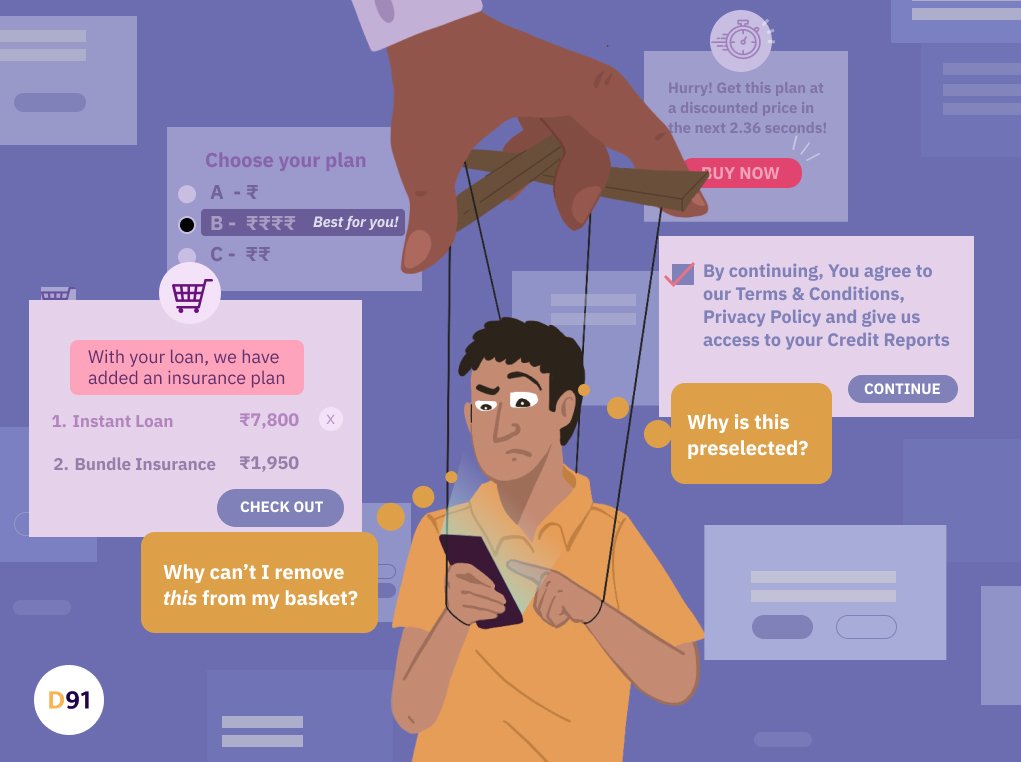
As dark patterns and their effects on users emerge in Europe and the US, India is also becoming aware of their danger and is sounding the alarm, particularly in the fintech industry. The Pravana institute took 9 fintech apps in 4 areas (lending, insurance/insurtech , investment, and neobanking) and, based on the OECD taxonomy, was able to categorize the dark patterns identified. The result is clear: at least 6 dark patterns are highly prevalent in all the apps studied. Once again, the study calls for the implementation of ethical design, with benefits for both users and the market.

Eindhoven, Netherlands

July 19, 2023 - 1:00 pm to 5:00 pm (UTC+2)

ACM Conversational User Interfaces (CUI) 2023 will be held in Eindhoven, Netherlands from 19-21st July in 2023. The in-cooperation conference will integrate a workshop organized into two sessions. Both the conference and the workshop are to be held in a hybrid format. The workshop will be held through a keynote by Colin Gray on dark patterns in a surveillance capitalistic world. These conferences/workshops highlight the major challenges of dark patterns in users' online experience, and highlight the risks they represent.

Framework Coworking 35 King Street · Bristol City

June 22, 2023 - 6:00 PM to 8:00 PM (UTC+1)

After their successful event "Generative AI: The next big revolution?" in March, Tech Ethics Bristol is organizing a new event "Dark Patterns: All you need to know". This event aims to explore the concept of Dark Patterns, their impact on our decisions, privacy, and autonomy, and the ethical implications of these deceptive design techniques. For this event, 4 speakers will shed light on the harms of dark patterns, how they erode trust, and what we can do about them. Speakers include Colin Gavaghan, Professor of Digital Futures at the University of Bristol. Lisa Talia Moretti, Digital Sociologist and User Research Principal at AND Digital. Ben Byford, Games Designer, Ethicist and Host of the Machine Ethics Podcast. Ray Newman, Senior content design consultant at SPARCK.


Office of the Privacy Commissioner

This event is scheduled to hold on the 10th of May, 2023 from 11:00 to 12:00

Ever wonder where the privacy settings are on Facebook? How often do you mindlessly agree to cookie consent pop ups without thinking? Are you bamboozled by opt in/out questions? These deceptive tricks are known as “dark patterns”: interface design techniques that aim to trick or mislead Internet users. In this talk, guest Dr. Alex Beattie reveals the degree of the presence of dark patterns across the New Zealand Internet. He demonstrates how dark patterns cluster around online financial transactions and discusses how these tricks actively undermine user privacy. He will show how dark patterns are deployed as mechanisms to drive business revenue, facilitate customer surveillance, and reduce business operations costs. The talk will conclude with a sneak peek about his future research into the efficacy of dark patterns.

Ahuja, Sanju & Kumar, Jyoti (2022)

This paper focuses on persuasion and user autonomy education. With the rise of persuasive features in interactive systems which are aimed at increasing revenue, gathering user information and maximising user engagement, users’ autonomy has been argued to be an ethical concern within persuasive UX design. Thus, the researchers test a framework to educate design students on the ethics of persuasion from the perspective of user autonomy. Findings showed that following this, their critical attitudes towards persuasive design increased. Based on this among others, they propose future directions for integrating ethics into user experience design.

Ahuja, Sanju & Kumar, Jyoti (2022)

This paper aims to conceptualize user autonomy within the context of dark patterns. The authors systematically review 151 dark patterns from 16 taxonomies to understand how dark patterns threaten users’ autonomy. They demonstrate through this analysis that implications for autonomy arise along four dimensions, because autonomy itself can be understood as subsuming several distinguishable concepts: agency, freedom of choice, control and independence. They argue that assessing whether a design pattern qualifies as ‘dark’ should account for the sense in which autonomy is threatened, as individuals’ rights and expectations of autonomy vary between contexts and depend upon the interpretation of autonomy. It aims to contribute to the development of the normative lens of individual autonomy for the evaluation of dark patterns and persuasive design.

Barros, Lirio, et al. (2023)

The authors begin the article by examining dark patterns and their prevalence based on extensive earlier research. It first discusses how behavioural economics can help us to understand the workings of dark patterns (the ‘old’), and how digitalization has changed the costs and benefits behind their implementation and exploitation (the ‘new’). They discuss how economics can inform ongoing policy discussions on appropriate regulatory responses, and how it can help to assess the effects of the use of dark patterns. They also assess two key developments in the digital space which have made dark patterns much more pervasive: minimal costs and vast gains. The effectiveness of competition policy and a healthy competition process as effective tools in curbing dark patterns are also assessed by the authors. Lastly, the article addresses important issues such as auditing and A/B testing for dark patterns, as well as using data on consumer outcomes to identify dark patterns as promising avenues to be explored in the further research and study of dark patterns.

Our clients