
Publications

Explore articles, jobs, talks, news, privacy,...

Learn about dark patterns, fair patterns and much more

Willing to dig further on dark patterns? Here are curated resources, including hundreds of publications we analyzed in our R&D Lab, conferences, webinars and job opportunities to fight dark patterns.
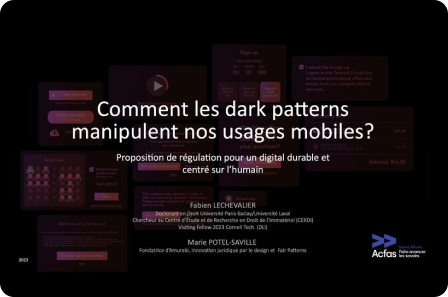
A large literature demonstrates that dark patterns fulfill their objectives more easily when they are used on mobile applications, in particular mobile game applications. The context of use of said applications generates decision-making based on System 1 (Kahneman) and heuristics, which is fast and inexpensive in terms of cognitive costs. Beyond the visible direct consequences, these techniques contribute to the reinforcement of generalized behavioral manipulation practices which question our collective relationship to the progress of techniques and question our social contract in the digital age. This communication given by Fabien Lechevalier of Laval University and Marie Potel of Amurabi aims to provide an overview of the regulatory framework governing dark patterns, identify its shortcomings, and to propose sustainable regulatory solutions that really take into account human cognitive limits.

This week on Legal Design Thinking IRL, Hannele Korhonen speaks with Marie Potel-Saville. They talk about the dark patterns of the internet, how to identify them and how she’s leveraging legal design to create fair patterns for users. They discuss what dark patterns are, how they affect our everyday lives, how to spot them, why they are bad for businesses, what laws and international standards govern dark patterns, what fair patterns are, how legal design can create fair patterns, why a human-centric approach to users, UX and their interactions with your business is crucial, and how to report dark patterns.

Competition and Markets Authority (2023)

Following the CMA's open letter to online businesses regarding urgency and price reduction claims, the Authority published this document featuring examples where common claims made by online businesses to consumers during the shopping process may breach the law, for example by misleading consumers or by putting unfair pressure on them.

Consumer Policy Research Centre (2022)

Deceptive designs range from those that are ubiquitous and frustrating for consumers to those that are misleading and deceptive and can lead to significant consumer harm. In light of this, this report considers the common types of dark patterns, the impact of dark patterns on consumers, and the next steps businesses, governments, and consumers can take to reduce harm.

Consumer Policy Research Centre (CPRC) (2023)

The central idea of this working paper is that issues of safety and fairness can no longer be regulated using consumer choice as the primary protection. Instead, consumers need a privacy law that stops harmful business practices before they cause significant harm. Two concepts are explored in this working paper to address both current and emerging data harms: duty of care or best-interests duty and the privacy safety regime. Borrowing concepts from product intervention powers and product safety interventions, the CPRC proposes options that would allow governments and regulators to stop or limit obviously harmful uses of data as well as a process for regulators to proactively restrict and test new harmful practices as they evolve. It concludes that the law needs to require more effort on the part of businesses to assess whether and how they collect, share, and use data that results in fair outcomes for their customers.

Rosca, Constanta (2023)

The concept of dark patterns is still ill-conceptualized in the Digital Services Act, the first EU legislative act to tackle dark patterns head-on. The author identifies these concerning aspects to the DSA's prohibition of dark patterns, notably its reference to manipulation as a source of consumer harm. ‘Manipulation’ is not defined in the regulation, and is a new EU legal term. Many philosophers have reflected on the meaning of manipulation and how it manifests in digital environments, and the jury is still out on this question. This article assesses this and related shortcomings, as well as others in relation to the IMCO Committee's proposed amendment of the Unfair Commercial Patterns Directive to better target dark patterns.

Dinner, Isaac et al. (2011)

Default decisions-prevalent and influential in areas varying from retirement program designs and organ donation policies to consumer choice. While past research has shown the reason for these no-action defaults mattering due to effort and implied endorsement, there is a dearth of this in relation to reference dependence, i.e. how the default choice can serve as a reference for determining whether the other choices will be positively or negatively evaluated. In the article, the researchers demonstrate how reference dependence can increase the effectiveness of default decisions.

Epson, Nick, BlueLabel (2023)

The world seemingly becomes more consumer-friendly with each generation as businesses take more and more measures to ensure customers are left with a positive experience. Despite our technological advancement and understanding of human nature, it’s still common to see deception in digital products. To understand digital deception (and better define it), we surveyed 536 people to measure and discuss people’s understanding of this matter.

European Commission (Directorate-General for Justice and Consumers) (2022)

The research conducted for this study is significant because it shows that dark patterns are prevalent and increasingly used by traders of all sizes and not only large platforms. According to the mystery shopping exercise, 97% of the most popular websites and apps used by EU consumers deployed at least one dark pattern and more importantly identified that it was rare to find one dark pattern used in isolation as multiple were often featured on a site. Altogether, it sheds light on the prevalence of dark patterns in the digital world and how a large number of internet players have a hand in this phenomenon.


European Data Protection Board (EDPB) (2022)

The Guidelines offer practical recommendations to designers and users of social media platforms on how to assess and avoid ‘dark patterns’ in social media interfaces that infringe on GDPR requirements. It is important to note that the list of dark patterns and best practices, as well as the use cases, are not exhaustive. Social media providers remain responsible and accountable for ensuring the GDPR compliance of their platforms.

Our clients