Publications

Explore articles, jobs, talks, news, privacy,...

Learn about dark patterns, fair patterns and much more

Willing to dig further on dark patterns? Here are curated resources, including hundreds of publications we analyzed in our R&D Lab, conferences, webinars and job opportunities to fight dark patterns.

Vibhav Singh, Niraj Kumar Vishvakarma and Vinod Kumar

This research examines the obstacles to overcoming dark patterns in e-commerce, manipulative strategies that companies use to influence consumer behavior. Employing total interpretive structural modeling (TISM) and expert insights, the study identifies major barriers like user unawareness and trust in brands. It also highlights the challenges posed by designer bias and user fatigue. The goal is to educate consumers, assist regulatory bodies, and promote ethical design standards in e-commerce.

Storbjörk, Sara

This study examines the motives behind the use of privacy dark patterns and their impact on user decision-making. Privacy dark patterns are deceptive design strategies that manipulate users into making privacy-compromising choices. By reviewing existing literature, the study identifies twelve common dark patterns and explores how the dual-process theory and privacy fatigue contribute to their effectiveness. Recent advancements in machine learning have shown promise in detecting these patterns, particularly in cookie dialogs. The enforcement of GDPR compliance remains a critical factor, relying on standardization and supervisory authorities.

Arya Ramteke, Sankalp Tembhurne, Gunesh Sonawane and Prof. Ratnmala N. Bhimanpallewar

This study investigates the detection of dark patterns in e-commerce websites, which are deceptive user interfaces designed to manipulate consumer behavior. Building on existing solutions like UIGuard and other machine learning approaches, the proposed method combines web scraping techniques with fine-tuned BERT language models. By analyzing scraped textual content, the study leverages BERT's bidirectional sentence analysis to identify and explain dark patterns, aiming to enhance consumer protection and raise awareness of these unethical practices.
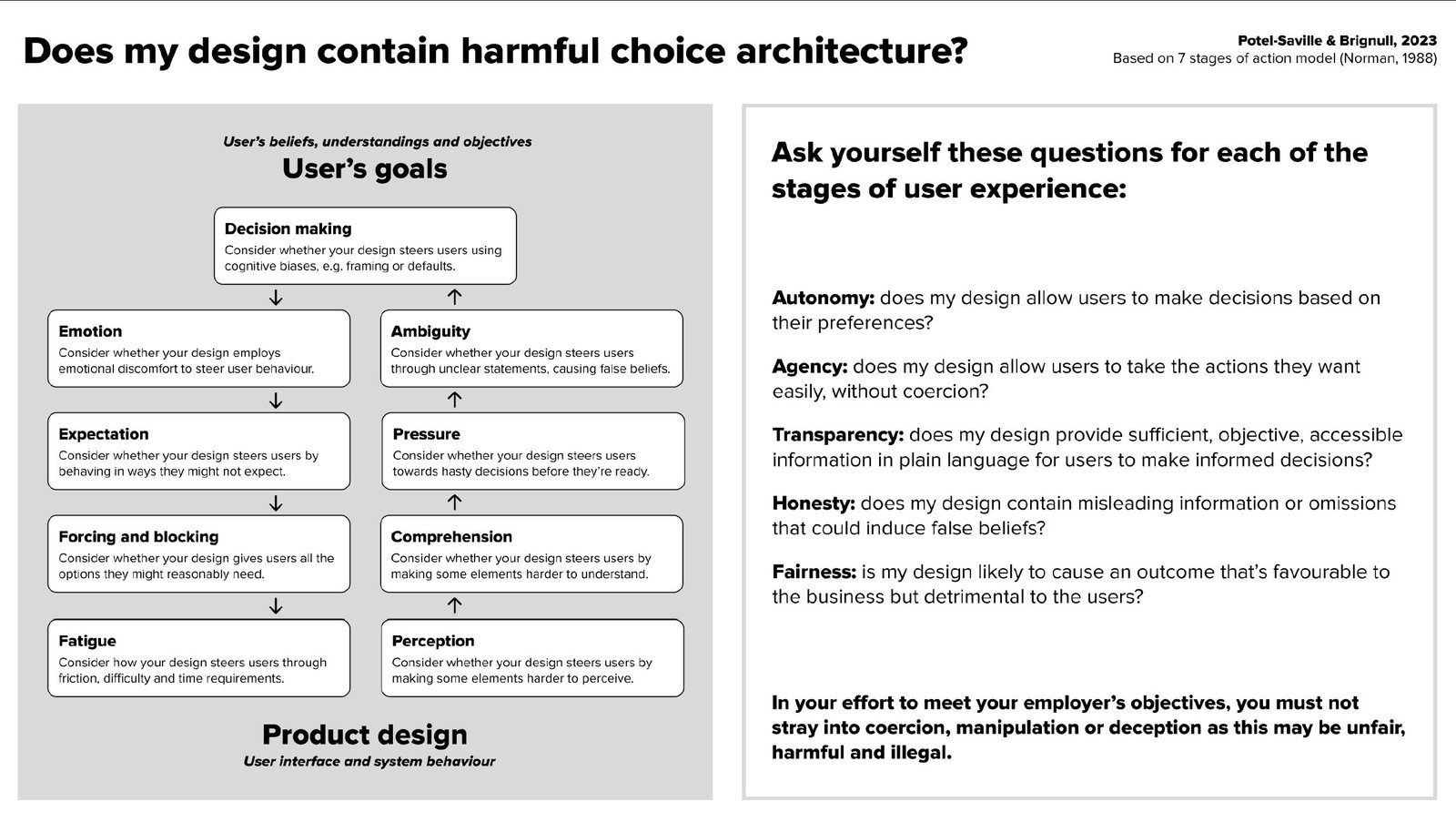
The design of online user interfaces significantly influences consumer choices, often using manipulative or deceptive practices. EU laws like the Consumer Rights Directive and the GDPR aim to protect consumer autonomy in the digital sphere. With the European Commission's upcoming digital fairness fitness check, a potential 'Digital Fairness Act' is on the horizon. Join CERRE on June 25, from 12:30 to 13:45 CEST, for a discussion on harmful online choice architecture, featuring experts from various sectors. Registration is required, and the event will be available for replay on the CERRE YouTube channel.

Ethical Design: X principles and how to apply them

Le legal design, pour rendre le droit transparent, accessible et actionnable

Dans cet épisode du podcast UX Content Craft, Apolline Rouzé* (animatrice du podcast), Senior UX writer et co-fondatrice de Lorem UX writing, échange avec Marie Potel-Saville, fondatrice d’Amurabi et de Fairpatterns.

What are the Basic Principles of UX and UI Design?

In the realm of digital interfaces, user experience (UX) and user interface (UI) design are paramount. They determine how users interact with products and services, influencing satisfaction, usability, and ultimately, success. Understanding the basic principles of UX and UI design is crucial for creating intuitive, effective, and engaging digital experiences. This article delves into the core principles of UX and UI design, drawing insights from our Head of Design, Guillemette de Brabant.

K. V. Sai Phani, K. Madhu Venkatesh, M. Bharath Kumar, B. Deekshith, B. Rakesh Reddy and M. Sai Charan

"Dark patterns" are deceptive design techniques used to manipulate users into actions they might not otherwise take, such as clicking on unwanted links or making unintended purchases. This paper examines the prevalence of dark patterns in the digital world, their potential harm to users, and strategies to eliminate their use. By understanding and identifying these sneaky tactics, users can avoid unnecessary expenses and save time. Unveiling dark patterns is crucial for detecting them on websites and raising awareness, ultimately protecting users from financial loss.

Colin M. Gray, Ritika Gairola, Nayah Boucaud, Maliha Hashmi, Shruthi Sai Chivukula, Ambika R. Menon and Ja-Nae Duane

In the evolving tech landscape, new regulations are impacting User Experience (UX) design. This paper examines how UX practitioners integrate legal knowledge into their work through three case studies: a junior designer in a startup, a mid-level practitioner in a corporation, and a senior consultant. The study reveals varying levels of legal awareness and integration, highlighting the need for researchers and educators to adapt UX practices to better address legal and regulatory issues.

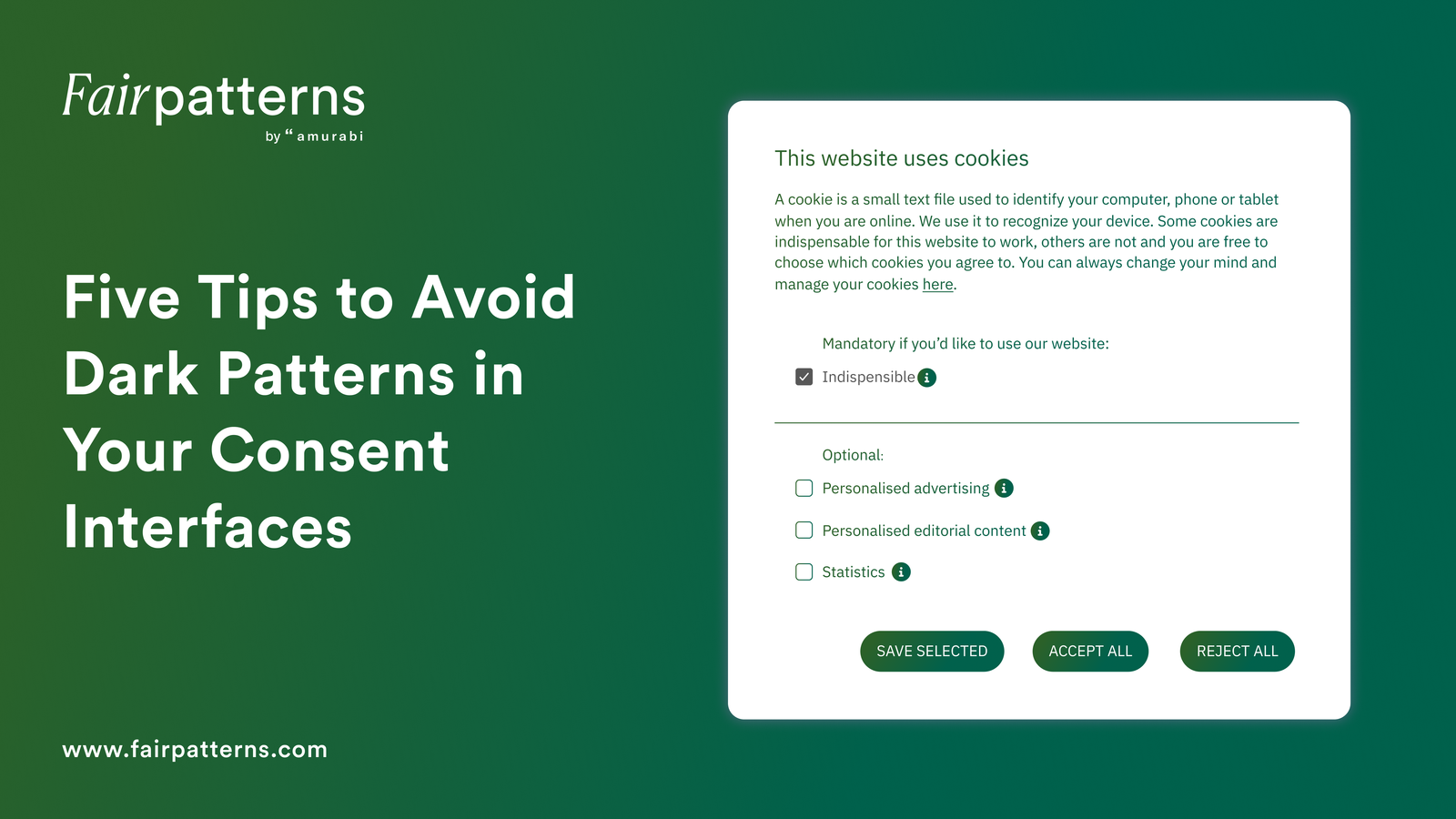
Five Tips to Avoid Dark Patterns in Your Consent Interfaces

As a digital marketer, legal director, or head of UX, you know that user consent for data collection is crucial. However, the design of consent interfaces can impact user trust and regulatory compliance. Dark patterns—deceptive design tactics—can invalidate consent, harm your brand, and incur fines. At FairPatterns, we advocate for fairness by design to ensure transparency and trust. Here are five tips to avoid dark patterns in your consent interfaces.


Our clients