Publications

Explore articles, jobs, talks, news, privacy,...

Learn about dark patterns, fair patterns and much more

Willing to dig further on dark patterns? Here are curated resources, including hundreds of publications we analyzed in our R&D Lab, conferences, webinars and job opportunities to fight dark patterns.

Commission Nationale Informatique & Libertés (CNIL) (2019)

Design is promising in a world which prizes beauty and functionality. With this understanding, web giants have customised their experiences, competed to attract users, and influenced as substantially as possible, their behaviours across diverse fields. However, this model is not followed any longer perhaps in light of the growing concerns about the utilisation of personal data. Laws like the General Data Protection Regulation (GDPR) also have offered instruments to make users the focus of the data economy. This article focuses on proposing operational recommendations to strengthen the choices to which users are entitled through design solutions.
Competition and Markets Authority (2022)

This paper discusses the current CMA thinking in this important area for its ongoing programme of competition and consumer enforcement. It also explains why online choice architecture is relevant to both consumer protection policy and competition policy and outlines a novel taxonomy of practices.

Competition and Markets Authority (CMA), 2023

The purpose of this open letter is to help businesses understand and comply with their existing obligations under consumer protection law when making urgency claims (for example, countdown timers, scarcity or ‘act fast’ messages) and/or price reduction claims online. The letter includes examples where common claims made by online businesses to consumers during the shopping process may breach the law, for example by misleading consumers or by putting unfair pressure on them.

Sinders, Caroline (2023)

In this publication, the author explores the malicious, confusing, and deceitful things that occur after signing up for digital services, as well as how design can nudge us to forget about a free trial or accidentally sign up for things that we didn’t intend to. In an experiment carried out from August 2 to October 4, 2022, the author attempted to unsubscribe from 16 online services which in turn knowingly or unknowingly made it difficult to do so. She recorded all the different kinds of problems that occurred, and all the websites engaged in bad or confusing tactics at some point, even after successfully unsubscribing.
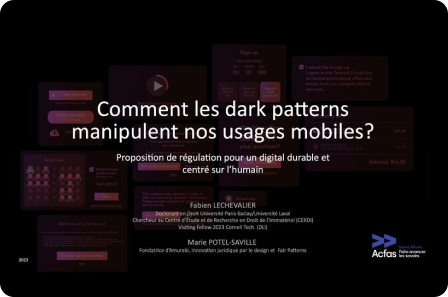
A large literature demonstrates that dark patterns fulfill their objectives more easily when they are used on mobile applications, in particular mobile game applications. The context of use of said applications generates decision-making based on System 1 (Kahneman) and heuristics, which is fast and inexpensive in terms of cognitive costs. Beyond the visible direct consequences, these techniques contribute to the reinforcement of generalized behavioral manipulation practices which question our collective relationship to the progress of techniques and question our social contract in the digital age. This communication given by Fabien Lechevalier of Laval University and Marie Potel of Amurabi aims to provide an overview of the regulatory framework governing dark patterns, identify its shortcomings, and to propose sustainable regulatory solutions that really take into account human cognitive limits.
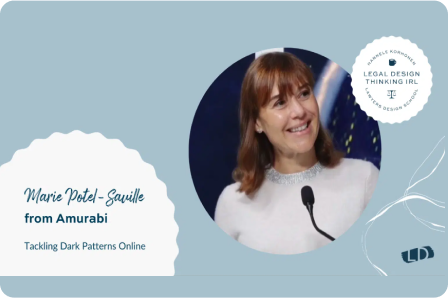
This week on Legal Design Thinking IRL, Hannele Korhonen speaks with Marie Potel-Saville. They talk about the dark patterns of the internet, how to identify them and how she’s leveraging legal design to create fair patterns for users. They discuss what dark patterns are, how they affect our everyday lives, how to spot them, why they are bad for businesses, what laws and international standards govern dark patterns, what fair patterns are, how legal design can create fair patterns, why a human-centric approach to users, UX and their interactions with your business is crucial, and how to report dark patterns.

Competition and Markets Authority (2023)

Following the CMA's open letter to online businesses regarding urgency and price reduction claims, the Authority published this document featuring examples where common claims made by online businesses to consumers during the shopping process may breach the law, for example by misleading consumers or by putting unfair pressure on them.

Consumer Policy Research Centre (2022)

Deceptive designs range from those that are ubiquitous and frustrating for consumers to those that are misleading and deceptive and can lead to significant consumer harm. In light of this, this report considers the common types of dark patterns, the impact of dark patterns on consumers, and the next steps businesses, governments, and consumers can take to reduce harm.

Consumer Policy Research Centre (CPRC) (2023)

The central idea of this working paper is that issues of safety and fairness can no longer be regulated using consumer choice as the primary protection. Instead, consumers need a privacy law that stops harmful business practices before they cause significant harm. Two concepts are explored in this working paper to address both current and emerging data harms: duty of care or best-interests duty and the privacy safety regime. Borrowing concepts from product intervention powers and product safety interventions, the CPRC proposes options that would allow governments and regulators to stop or limit obviously harmful uses of data as well as a process for regulators to proactively restrict and test new harmful practices as they evolve. It concludes that the law needs to require more effort on the part of businesses to assess whether and how they collect, share, and use data that results in fair outcomes for their customers.

Rosca, Constanta (2023)

The concept of dark patterns is still ill-conceptualized in the Digital Services Act, the first EU legislative act to tackle dark patterns head-on. The author identifies these concerning aspects to the DSA's prohibition of dark patterns, notably its reference to manipulation as a source of consumer harm. ‘Manipulation’ is not defined in the regulation, and is a new EU legal term. Many philosophers have reflected on the meaning of manipulation and how it manifests in digital environments, and the jury is still out on this question. This article assesses this and related shortcomings, as well as others in relation to the IMCO Committee's proposed amendment of the Unfair Commercial Patterns Directive to better target dark patterns.

Our clients