
Publications

Explore articles, jobs, talks, news, privacy,...

Learn about dark patterns, fair patterns and much more

Willing to dig further on dark patterns? Here are curated resources, including hundreds of publications we analyzed in our R&D Lab, conferences, webinars and job opportunities to fight dark patterns.

Matthew Gaulton, Dominique Kelly and Jacquelyn Burkell

This paper assesses upcoming bills intended to replace Canada's PIPEDA, with a specific focus on strengthening privacy protections against dark patterns. While existing scholarship, such as Wiener's and Adeyoju's works, has critiqued current legislation, this study provides a detailed review of new legislative proposals. Through a comparative analysis with frameworks like California's CCPA and the EU's GDPR, the paper evaluates the proposed changes' efficacy. The aim is to determine how Canada's legislative efforts align with international standards in addressing the challenges posed by dark patterns.

Dominique Kelly and Jacquelyn Burkell

Privacy dark patterns are deceptive user interface designs nudging users to share personal data, often seen in social media defaults and hidden "skip" buttons. A project targeting Canadian youth's experiences with these patterns revealed limited initial awareness. However, when prompted, teens could identify and resist these tactics. The study also reviewed regulatory approaches across Canada, the US, and the EU, aiming to inform effective frameworks and educational resources to empower users against these manipulations.



Philippe Valoggia, Anastasia Sergeeva, Arianna Rossi and Marietjie Botes

In recent research, the privacy engineering literature, while outlining design requirements, often lacks practical implementation strategies. Concurrently, "dark patterns"—deceptive interface designs—are increasingly bypassing these standards. Through expert analysis aligning dark patterns with ISO/IEC 29100:2011 Privacy Principles, clusters of potential violations were identified. This study underscores the need for practical guidelines to ensure technology designs uphold recognized privacy standards.

Vicky Chung, Dominique Kelly and Jacquelyn Burkell

Despite users' awareness of deceptive UI design tactics, known as dark patterns, their behavioral responses often diverge from this knowledge. Studies indicate users can identify and feel annoyed by these manipulations, yet they frequently succumb to them, such as consenting to tracking or unintended subscriptions. Advancements in automatic detection methods highlight the growing tech-driven efforts to combat these practices. Consequently, there's a pressing need for regulatory measures to ensure ethical UI design and protect user autonomy online.

The Artificial Intelligence Act, one of the world's first binding pieces of legislation on AI, focuses on ethical use, prohibiting the use of dark patterns within AI systems. It aims to ensure AI systems do not exploit user vulnerabilities, balancing technological innovation and consumer protection. The final text was recently approved by the EU Council and awaits signature.

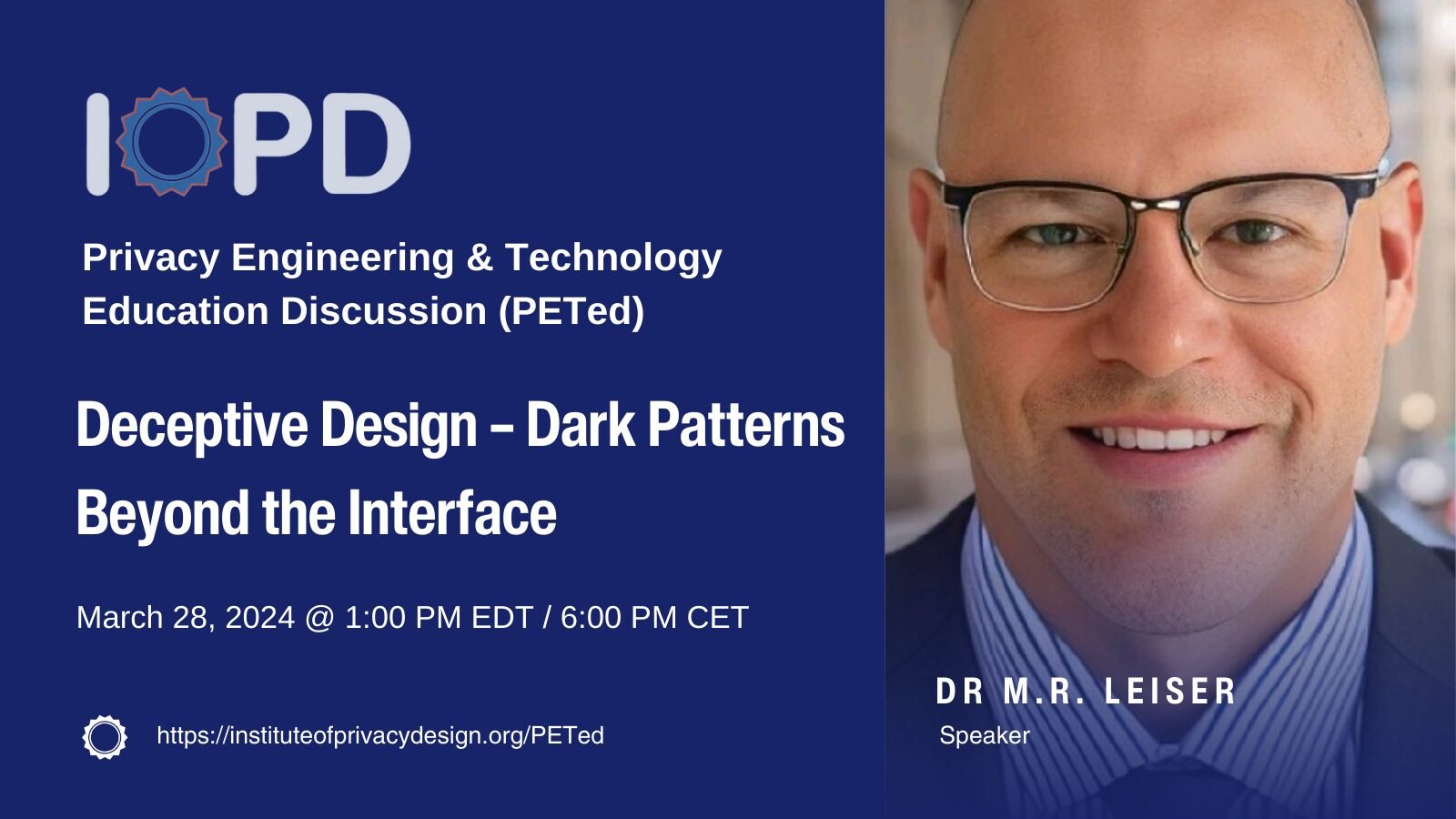
https://iopd.whereby.com/peted-discussion

28 March 2024 6:00 PM CET / 1:00 PM EDT

Join for a riveting exploration into the murky waters of 'dark patterns' online. Delve into how these cunning design strategies compromise autonomy and wallets. Dr. Leiser will dissect current laws like the GDPR and Digital Services Act, revealing how Big Tech outmaneuvers them. Attendees will learn to spot these traps and leverage legal mechanisms for protection. It's a call for more vigilant digital citizenship in the face of technology's ubiquitous influence.

Ophelia Prillard, Costas Boletsis and Shukun Tokas

The burgeoning metaverse presents unprecedented privacy challenges, particularly concerning the extensive data collection capabilities of XR devices. Through a case study of Meta Horizon Workrooms, this research identifies key obstacles, such as opaque privacy policies and complex user interfaces. Drawing on established best practices, ethical design solutions are proposed, including informed user interfaces and clearer consent procedures, aiming to mitigate privacy concerns and foster a more transparent digital environment.

Claire Bessant, Laurel Aynne Cook, Luei Lin Ong, Alexa Fox, Mariea Grubbs Hoy, Pingping Gan, Emma Nottingham, Beatriz Pereira and Stacey Steinberg

Dark design, characterized by deceptive user interfaces aimed at manipulating user behavior, poses significant risks, especially for children. This paper delves into the influence of dark design across various digital mediums and age groups, alongside parental awareness and the efficacy of marketplace and regulatory controls. By addressing these concerns, it aims to contribute to safeguarding children's online experiences from deceptive practices.

Mathew Iantorno, Dan Guadagnolo and Adrian Petterson

This conference paper addresses the underexplored area of "dark patterns" in digital marketing and interface design, which manipulate users into actions against their interests. By integrating perspectives from diverse disciplines such as business, marketing, science, and disability studies, the paper showcases three curriculum-building projects. These projects aim to broaden the definition of dark patterns and incorporate them into university courses, introducing them as valuable pedagogical concepts within communications, technology, and design disciplines.

Mario Arias-Oliva, Jorge Pelegrín-Borondo, Kiyoshi Murata, Ana María Lara Palma and Manuel Ollé Sesé

Alan M. Turing's inquiry from 1950 on whether machines can think is more relevant than ever as Artificial Intelligence (AI) advances rapidly, outstripping human capabilities in various domains. However, as AI takes on more decision-making roles in businesses, concerns about transparency, interpretability, and ethics emerge. This article discusses the importance of Explainable AI (XAI) in fostering ethical decision-making within the business realm, addressing the need for transparency and accountability in AI systems.

Our clients